
Bengaluru Startup Combines Dogs and AI to Sniff Out Early Cancer
Bengaluru startup Dognosis is revolutionizing early cancer detection by integrating trained sniffer dogs with AI. The non-invasive method analyzes breath samples, showing promising results in early-stage cancer sensitivity and aiming to address low screening rates in India. While in trials and categorized as a prescreening tool, it offers a cost-effective path to widespread early detection.
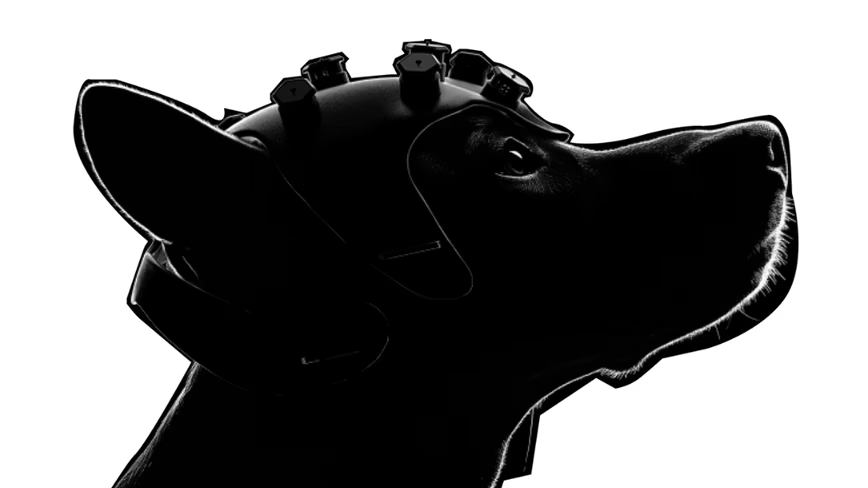
A two-year-old Bengaluru startup, Dognosis, is pioneering an innovative approach to early cancer detection by merging the superior olfactory capabilities of trained dogs with advanced artificial intelligence. The company aims to provide a non-invasive, cost-effective prescreening tool that could significantly improve cancer detection rates, particularly in regions with limited access to traditional diagnostic methods.
Dognosis's method is deceptively simple for patients. Individuals breathe into a mask, which is then securely transported to the startup's facility, a farm nestled outside Bengaluru. Here, a specialized team of dogs, including beagles, labradors, and Dutch shepherds, are trained to sniff these breath samples for subtle chemical signatures indicating the presence of tumors.
As the dogs interact with the samples, an intricate system of sensors and AI monitors their physical and neurological responses. This includes tracking their movements, respiration patterns, brain activity, and body language. A simple pause or a tail wag from a dog is then translated by the AI into structured data, allowing for a standardized and repeatable analysis. This entirely sidesteps the need for invasive procedures like biopsies, blood draws, or complex imaging scans often associated with cancer detection.
Founded by Akash Kulgod, Dognosis states its technology can target more than 20 types of cancer across seven categories, including prevalent forms like breast, oral cavity, lung, and cervical cancers. The company reported impressive preliminary results from its Phase 2 trials, published in the Journal of Clinical Oncology, showing approximately 90% sensitivity for early-stage cancers. Additionally, Dognosis claims that dogs trained on 10 specific cancer types were able to identify an 11th type they had not previously encountered. It is important to note that these accuracy and detection figures are currently reported by the company and its researchers, awaiting independent confirmation.
Addressing India's Cancer Challenge
The Dognosis approach is particularly relevant given India's significant cancer burden and low screening rates. In 2024, the country recorded about 1.5 million new cancer cases and over 900,000 deaths, making it one of the heaviest caseloads globally. Despite this, screening rates remain remarkably low, with roughly 1.9% of women screened for cervical cancer and less than 1% for breast or oral cancers. This gap is largely attributed to factors such as high costs, geographical distance to facilities, and patient discomfort with invasive procedures.
A cheap, non-invasive prescreening tool could dramatically expand access to early detection for a large population that the traditional healthcare system currently struggles to reach. This is precisely the critical market Dognosis aims to serve with its innovative solution.
Funding and Future Outlook
Dognosis secured a $1.5 million pre-seed funding round in 2024 and has since closed another undisclosed round, attracting notable investors like Accel India and Caffeinated Capital. The startup has an ambitious roadmap, planning to launch an at-home, multi-cancer prescreening test in India next year, with an estimated price point of a few thousand rupees.
Currently, a Phase 3 trial is underway, initiated in April, with plans to enroll approximately 10,000 participants across 10 hospitals. The company targets performing a million tests annually with a one-week turnaround, supported by a team of around 30 highly trained dogs. Looking further ahead, Dognosis has penciled in the establishment of a US facility for late 2027 or early 2028.
Important Caveats and Regulatory Landscape
While promising, there are important distinctions to highlight. Dognosis operates as a prescreening tool, designed to flag individuals who should seek further medical evaluation, rather than providing a definitive diagnosis. This distinction is crucial and will require careful communication from the company to patients.
Kulgod noted a regulatory nuance in India: because Dognosis offers a prescreening tool and not a formal diagnostic device, it does not require Indian regulatory approval to launch. While this lowers the barrier to market entry, it also implies that the technology may reach patients without undergoing the rigorous approval processes typically required for official diagnostic medical devices. Furthermore, the trials are still in their early stages, and the long-term efficacy and reliability need to be established through larger, independent studies.
Intriguingly, Dognosis envisions a future where the trained dogs are eventually replaced by sophisticated sensors, effectively distilling the biological prowess of a canine nose into advanced hardware. Regardless of this future evolution, the fundamental concept — leveraging the unparalleled biosensing ability of dogs, standardized by AI, to address critical gaps in cancer screening — represents a significant and compelling leap in preventative healthcare.
FAQ
Q: What is Dognosis's core technology for cancer detection?
A: Dognosis combines the acute sense of smell of trained sniffer dogs with artificial intelligence and bio-sensors. Patients breathe into a mask, which dogs then sniff. The AI interprets the dogs' reactions (movements, respiration, brain activity) to identify chemical signatures of cancer in the breath sample.
Q: What are the primary benefits of this cancer prescreening approach?
A: The main benefits include its non-invasiveness, potential low cost, and accessibility, making it suitable for widespread early detection. It can target over 20 cancer types and aims to bridge the gap in screening rates, particularly in regions where traditional diagnostics are expensive or hard to reach.
Q: What are the current limitations or caveats of the Dognosis system?
A: Dognosis is a prescreening tool, not a diagnostic, meaning a positive result prompts further medical investigation rather than a definitive diagnosis. Its reported accuracy figures are currently company-reported and require independent confirmation. Additionally, in India, it operates without regulatory approval typically required for diagnostic devices, as it's classified differently, and the technology is still in early trial phases.
Related articles

Apple Unveils iPhone Duo: Pricey Foldable Sees Soaring Demand
Apple has officially entered the foldable smartphone arena with the long-anticipated launch of the iPhone Duo. Priced starting at a hefty $1,999, the device features a 5.4-inch outer display and a larger 7.6-inch inner

in-depth: Chicago-Area Cops Helped HSI Spy on Minnesota Anti-ICE
Chicago-area law enforcement, including local police and HSI agents, conducted undercover surveillance on Minnesota anti-ICE activists at an April 2, 2022, talk in Chicago. This operation was part of a federal conspiracy probe into 15 Minnesota activists facing felony charges related to immigration enforcement resistance. Civil liberties advocates have condemned the surveillance as a troubling intrusion into protected political activity.

Mark Wahlberg on using AI in film ‘the right way’ and being open to
Actor Mark Wahlberg believes AI has a place in filmmaking if used responsibly for enhancement, not script generation or actor replacement. At TechCrunch Disrupt, he expressed openness to an AI likeness carrying on his legacy, managed by his family, and emphasized storytelling.

Tesla Unveils Thruster-Equipped Roadster, 2028 Production Targeted
Tesla has unveiled its second-generation Roadster, featuring cold-gas thrusters co-developed with SpaceX, enabling it to jump and flip. The electric sports car demonstrated 0-60mph in an astonishing 0.81 seconds, with production targeted for 2028. This highly anticipated reveal also serves as a key recruitment tool for Tesla's ambitious AI and robotics initiatives.

AI's Confidence vs. Formal Methods' Rigor: Design Flaws & Verification
While AI accelerates code generation, formal methods remain critical for ensuring system correctness. Languages like TLA+ and tools like Quint enable developers to model and verify system designs before coding, catching subtle flaws. Quint makes formal methods more accessible with developer-friendly syntax and executability. This approach is vital for verifying AI-generated code through trace validation and model-based testing, ensuring reliability against real-world data.

Amazon Prime Video Launches AI-Powered Prime 360 for NBA Coverage
Amazon Prime Video is elevating its NBA coverage with the introduction of Prime 360, an AI-powered replay system offering immersive, 'fly through' views of the action. Kicking off its second season, Prime Video also adds Yahoo fantasy integration and gains exclusive Eastern Conference Finals rights, expanding its tech-driven sports broadcast. The new features aim to deliver a unique and interactive viewing experience for basketball fans.