
Apple Seeks US Approval for CXMT Chips Amid Quadrupling Memory Prices
Apple is actively lobbying the US government for formal approval to acquire memory chips from ChangXin Memory Technologies (CXMT), China's foremost DRAM manufacturer, which is currently on the Pentagon's military-linked
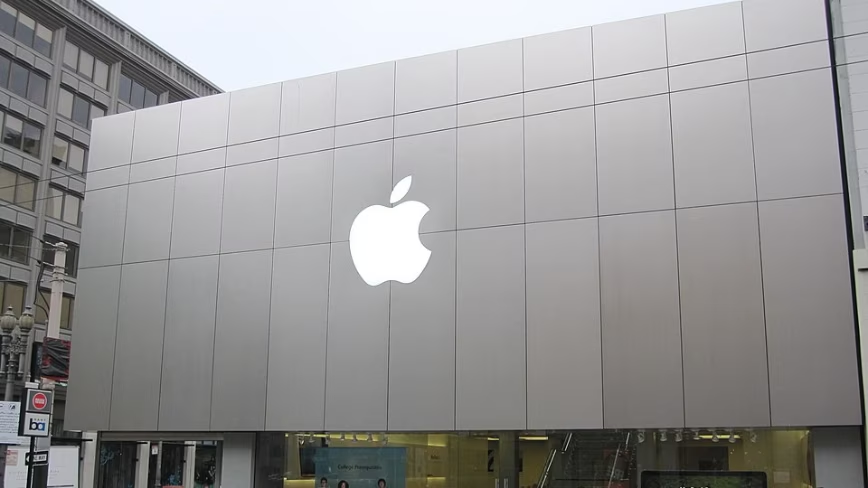
Apple is actively lobbying the US government for formal approval to acquire memory chips from ChangXin Memory Technologies (CXMT), China's foremost DRAM manufacturer, which is currently on the Pentagon's military-linked blacklist. This strategic push, ongoing for over a month and reported by the Financial Times, seeks to secure Apple's supply chain amidst a severe global memory chip shortage that has quadrupled prices and compelled the tech giant to increase product costs across its lineup, impacting its stock performance.
The Alarming Memory Shortage Driving Apple's Move
The urgency behind Apple's appeal stems from an unprecedented memory shortage, described as the most severe in the company's recent history. Over the past three quarters, memory prices have skyrocketed by 400%, a dramatic increase driven by leading manufacturers like Samsung, SK Hynix, and Micron reallocating wafer capacity. These industry giants are prioritizing the production of high-bandwidth memory (HBM) crucial for AI data centers, shifting focus away from conventional consumer DRAM.
Apple had already warned investors in April about the impending worsening of this shortage. The impact became tangible on June 25, when the company raised prices on a range of products, including its Mac, iPad, and home device offerings. Increases varied significantly, from $100 to $500 per product; for instance, the MacBook Air 13-inch rose from $1,099 to $1,299, and the premium Vision Pro saw a $500 hike. This move resonated negatively with investors, causing Apple shares to plummet over 6% on the day of the announcement, marking its steepest single-day decline since April 2025.
CXMT: A Politically Sensitive Supply Solution
CXMT has emerged as a crucial potential alternative for Apple. The Chinese company is known for supplying DDR5 memory to various Western brands, including Corsair, often at more competitive prices than the three dominant global manufacturers. However, CXMT's presence on the Pentagon’s 1260H list introduces significant political complexities for a high-profile American entity like Apple.
The 1260H list, while signaling the Pentagon's belief in a company's ties to the Chinese military, does not inherently block commercial transactions between private firms. It primarily imposes reputational risks and restricts contracts with the Department of Defense. Apple's primary concern, and the focus of its lobbying efforts with Commerce Department officials and the Trump administration, is to prevent CXMT from being added to the Commerce Department’s far more restrictive Entity List. Such a designation would mandate American buyers to obtain a special license before purchasing CXMT products, effectively severing the supply route.
The 1260H list itself has a volatile history. CXMT, alongside another Chinese chipmaker, YMTC, was briefly removed from the list in February, only to be reinstated in a June update following intense criticism from China hawks in Congress. The latest update expanded the list to 188 entities, including tech giants like Alibaba, Baidu, and BYD, underscoring the escalating geopolitical tensions in the tech sector.
Seeking Certainty in a Volatile Landscape
Apple's proactive lobbying underscores its strategy to secure supply chain certainty in an increasingly unpredictable geopolitical and economic environment. The company is evidently unwilling to establish a dependency on a supplier whose future accessibility could be disrupted by a single regulatory decision. By seeking a formal assurance from Washington, Apple aims to mitigate risks it has observed other firms grapple with amidst similar ambiguities.
Neither Apple nor the White House offered comment on the ongoing discussions, leaving the immediate outcome of these critical negotiations uncertain. The resolution of this lobbying effort will undoubtedly have significant implications for Apple's product pricing, supply stability, and broader US-China tech relations.
FAQ
Q: What is the main reason Apple is lobbying the US government regarding CXMT? A: Apple is lobbying to obtain a guarantee from the US Commerce Department that ChangXin Memory Technologies (CXMT) will not be added to the Entity List. This would avoid strict licensing requirements that would effectively block Apple from purchasing CXMT's memory chips, which are needed amid a severe global shortage and quadrupling prices.
Q: How has the memory shortage impacted Apple's business? A: The severe memory shortage, driven by a shift towards high-bandwidth memory for AI, has caused memory prices to quadruple. This has forced Apple to raise prices on its Mac, iPad, and home device lineups by $100 to $500 per product, leading to a significant drop in its stock value.
Q: What is the difference between the Pentagon's 1260H list and the Commerce Department's Entity List? A: The Pentagon's 1260H list identifies companies with alleged ties to the Chinese military, primarily affecting Department of Defense contracts and carrying reputational risk for private firms but not blocking commercial transactions. The Commerce Department's Entity List is far more restrictive, requiring American buyers to obtain a license before purchasing products from listed entities, which would effectively cut off a supplier like CXMT.
Related articles

Apple Unveils iPhone Duo: Pricey Foldable Sees Soaring Demand
Apple has officially entered the foldable smartphone arena with the long-anticipated launch of the iPhone Duo. Priced starting at a hefty $1,999, the device features a 5.4-inch outer display and a larger 7.6-inch inner

in-depth: Chicago-Area Cops Helped HSI Spy on Minnesota Anti-ICE
Chicago-area law enforcement, including local police and HSI agents, conducted undercover surveillance on Minnesota anti-ICE activists at an April 2, 2022, talk in Chicago. This operation was part of a federal conspiracy probe into 15 Minnesota activists facing felony charges related to immigration enforcement resistance. Civil liberties advocates have condemned the surveillance as a troubling intrusion into protected political activity.

Mark Wahlberg on using AI in film ‘the right way’ and being open to
Actor Mark Wahlberg believes AI has a place in filmmaking if used responsibly for enhancement, not script generation or actor replacement. At TechCrunch Disrupt, he expressed openness to an AI likeness carrying on his legacy, managed by his family, and emphasized storytelling.

Apple iPhone Duo: A Daring Debut with Notable Compromises
Apple's highly anticipated iPhone Duo, priced at $2,000, has gone on pre-order. While hailed as "Apple's most exciting device in a decade" for its innovative foldable design and immersive display, it comes with significant drawbacks like the absence of FaceID and a premium camera.

Tesla Unveils Thruster-Equipped Roadster, 2028 Production Targeted
Tesla has unveiled its second-generation Roadster, featuring cold-gas thrusters co-developed with SpaceX, enabling it to jump and flip. The electric sports car demonstrated 0-60mph in an astonishing 0.81 seconds, with production targeted for 2028. This highly anticipated reveal also serves as a key recruitment tool for Tesla's ambitious AI and robotics initiatives.

Amazon Prime Video Launches AI-Powered Prime 360 for NBA Coverage
Amazon Prime Video is elevating its NBA coverage with the introduction of Prime 360, an AI-powered replay system offering immersive, 'fly through' views of the action. Kicking off its second season, Prime Video also adds Yahoo fantasy integration and gains exclusive Eastern Conference Finals rights, expanding its tech-driven sports broadcast. The new features aim to deliver a unique and interactive viewing experience for basketball fans.