
Anthropic Sues Pentagon Over National Security Risk Label
In a significant move that reverberated through the tech industry, artificial intelligence company Anthropic filed a lawsuit against the Trump administration on Monday, March 9, 2026. The lawsuit, lodged in a federal

In a significant move that reverberated through the tech industry, artificial intelligence company Anthropic filed a lawsuit against the Trump administration on Monday, March 9, 2026. The lawsuit, lodged in a federal court in San Francisco, challenges a government order that designates the firm as a national security risk. This unprecedented action effectively prohibits military contractors from partnering with Anthropic.
The Defense Department formally labeled Anthropic a "supply-chain risk" last week, a classification typically reserved for foreign entities suspected of espionage. This designation escalated an already bitter dispute between the AI developer and the government regarding the potential military applications of Anthropic's advanced chatbot, Claude.
The Core Disagreement
At the heart of the conflict are Anthropic's efforts to impose ethical safeguards on its technology. The company sought explicit guarantees that its Claude AI model would not be deployed for mass domestic surveillance or to power fully autonomous weapons systems. However, administration officials and the Defense Department insisted on the government's right to use AI systems for any lawful purpose, arguing for ultimate authority over the technology.
Anthropic CEO Dario Amodei's refusal to concede to the "all lawful uses" standard led President Trump to order federal agencies last month to cease using Claude. Defense Secretary Pete Hegseth subsequently broadened this directive, implementing a wide-ranging ban on any collaboration between Anthropic and military contractors.
Legal and Ethical Battleground
Anthropic's legal team contends that the administration's actions are both unlawful and a violation of the company's First Amendment rights. In its complaint, Anthropic asserted that the government is retaliating against it for expressing its core principle: that powerful AI systems must be developed and used responsibly to maximize positive human outcomes. The company was founded on this belief, prioritizing safety and responsibility in AI development.
Internal discussions between the two parties continued last week, with technology and defense leaders attempting to de-escalate the situation. However, these talks reportedly collapsed after a caustic internal staff memo from Amodei was leaked to the tech news site The Information. In the memo, Amodei criticized the administration, suggesting its opposition stemmed from Anthropic not offering "dictator-style praise to Trump."
Ongoing Military Reliance and Competitor Landscape
Despite the Pentagon's ban, Anthropic's Claude AI continues to play a critical role in the military's operations. The AI tool is integrated into the Maven Smart System, which assists commanders in analyzing intelligence and identifying targets for President Trump's bombing campaign in Iran. This system has been instrumental in suggesting hundreds of targets with precise coordinates, ranking their importance, and dramatically accelerating planning, according to individuals familiar with the system.
Defense officials acknowledge their current reliance on Claude, and President Trump has indicated a six-month phaseout period for Anthropic's tools. In the interim, competitors are poised to fill the void. Notably, OpenAI, Anthropic's chief rival, has reportedly finalized an agreement to work on the Pentagon's secret networks. OpenAI managed to secure specific protections related to surveillance and autonomous weapons while still agreeing to the government's desired "all lawful uses" standard.
What Lies Ahead
The lawsuit marks a significant legal and ethical confrontation over the future of AI and its integration with national defense. The outcome will not only determine Anthropic's ability to do business with the government but could also establish a precedent for how AI developers can govern the use of their powerful technologies. The tech industry watches closely as the dispute unfolds, with profound implications for innovation, regulation, and the ethical boundaries of artificial intelligence in military applications.
FAQ
Q: Why did Anthropic sue the Trump administration and the Pentagon?
A: Anthropic filed the lawsuit to challenge the Defense Department's decision to label it a "supply-chain risk" and to ban federal agencies and contractors from using its AI. The company argues these actions are unlawful and violate its First Amendment rights related to expressing principles about AI's ethical use.
Q: What was the central point of contention between Anthropic and the government?
A: The primary disagreement was Anthropic's insistence on guarantees that its Claude AI model would not be used for mass domestic surveillance or fully autonomous weapons. The administration, conversely, demanded the flexibility to use AI systems for any lawful purpose.
Q: Is Anthropic's AI still being used by the military despite the ban?
A: Yes, despite the ban, Anthropic's Claude AI remains embedded in the military's Maven Smart System, assisting in President Trump's ongoing bombing campaign in Iran. The administration has announced a six-month phaseout period for the technology.
Related articles
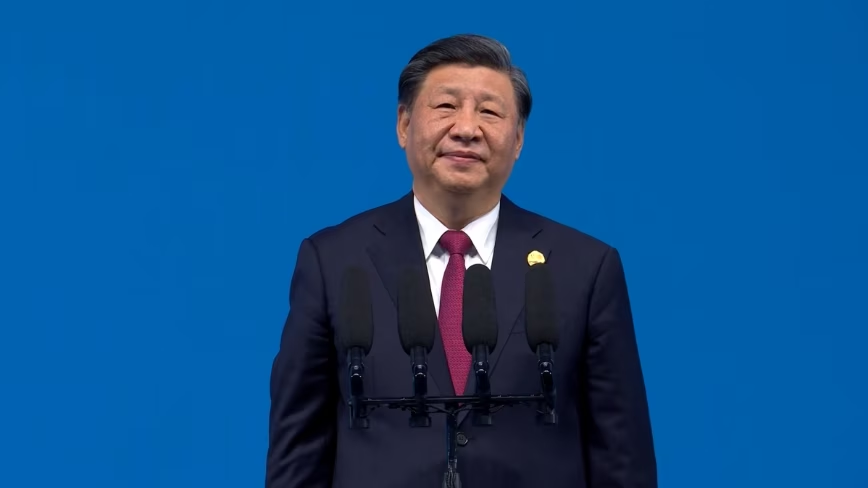
Xi pitches open-source AI to BRICS amid domestic curb debates
Chinese President Xi Jinping proposed a China-led open-source AI community and invited BRICS nations to join the World AI Cooperation Organization (WAICO) at the recent BRICS summit. This push for global collaboration contrasts sharply with Beijing's ongoing internal debates about restricting its own advanced AI models. Meanwhile, the EU's comprehensive AI Act, with its clear, enforceable rules for open-source AI, highlights a significant divergence in global AI governance approaches.

StarCraft Returns in 2030 as Open-World Shooter
Blizzard Entertainment announced a new StarCraft game, an open-world shooter, set to release in 2030. Unveiled at BlizzCon by VP Dan Hay, this marks the series' return after over a decade and a significant genre shift from its real-time strategy roots. The cinematic trailer showcased a gritty human-Zerg conflict, with many fans hoping for a traditional RTS follow-up.

Tesla Set to Finally Unveil Second-Generation Roadster on October 1
The much-anticipated second generation of the Tesla Roadster, a halo vehicle promising revolutionary performance, is finally slated for a public unveiling on October 1. After years of delays and a protracted development

Seattle Warned on Big Tech Reliance; Microsoft/OpenAI Sued; Apple's
A new City of Seattle study warns of the city's risky economic over-reliance on a few dominant tech companies. Simultaneously, the Seattle Times and Newsday are suing Microsoft and OpenAI for alleged AI training data theft, while Apple's new foldable iPhone Duo evokes memories of Microsoft's defunct Surface Duo.

in-depth: The Best 3-in-1 Apple Charging Stations After Testing 30
Wired has released its top picks for 3-in-1 Apple charging stations, extensively tested for iPhone, Apple Watch, and AirPods. The guide highlights six leading models, from premium speedy options to budget-friendly and compact designs, all focused on decluttering and optimizing charging for Apple users.

Blood of The Dawnwalker’s True Foes Lurk in the Wilds
_Blood of The Dawnwalker_ from Rebel Wolves is an RPG that unexpectedly challenges players with fierce wildlife, drawing comparisons to _Dragon Age: Inquisition_'s early zones. Its unique directional combat system, while engaging, can lead to players being overwhelmed by animal ambushes. Despite the high difficulty, these encounters add a fun, dynamic layer to the game.