
AMD Ryzen 5 7600X3D Review: Still the Best Value Gaming CPU
The AMD Ryzen 5 7600X3D remains an outstanding gaming CPU, offering near-flagship performance at a fraction of the cost, even 18 months post-launch. While it struggles in multi-threaded productivity tasks against Intel's latest, its efficiency and price point make it an unbeatable choice for dedicated gamers.
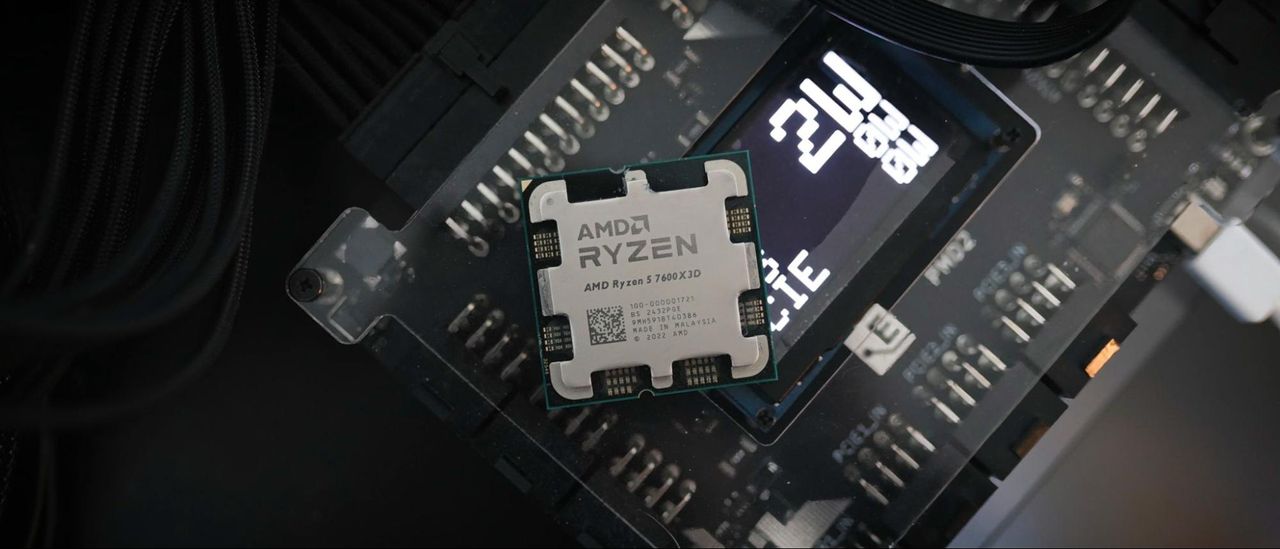
The AMD Ryzen 5 7600X3D, a processor that first surfaced 18 months ago, remarkably maintains its status as the premier value choice for gamers today. Originally an elusive Micro Center exclusive, it has finally made its way online, albeit with a slight price increase. While its gaming prowess remains almost untouched in its price bracket, it does concede ground in non-gaming applications, particularly against more recent offerings from Intel.
Quick Verdict
The Ryzen 5 7600X3D is, without a doubt, the best value gaming CPU currently available. It delivers exceptional frame rates that rival much more expensive chips, all while consuming very little power. However, users focused on productivity, content creation, or heavy multi-threaded workloads will find its performance lacking compared to its contemporaries. For pure gaming bang-for-buck, it’s an absolute winner.
Key Specifications
At its core, the Ryzen 5 7600X3D is a Zen 4 architecture chip, enhanced with AMD's 3D V-Cache technology. Here are its vital statistics:
- Architecture: Zen 4 X3D
- Cores/Threads: 6 Cores / 12 Threads
- Base/Boost Clock: 4.1 GHz / 4.7 GHz
- Total Cache (L2 + L3): 102 MB (96 MB 3D V-Cache L3 + 2MB L2)
- TDP / PPT: 65W / 88W
- Street Price: Approximately $240 online (or $200 in-store at Micro Center)
This processor uniquely combines a lower core count with a massive cache, optimized specifically for gaming performance, rather than raw clock speed or core count, which typically benefits productivity tasks.
Gaming Performance: Unrivaled in its Class
Where the Ryzen 5 7600X3D truly shines is in gaming. Despite its mid-range designation and lower clock speeds compared to its non-X3D siblings like the Ryzen 5 7600X, the massive 3D V-Cache makes an undeniable difference. Our extensive testing places it consistently high in CPU benchmark hierarchies, often delivering gaming performance that is only marginally slower than the much more expensive Ryzen 7 7800X3D.
In the $200 to $250 price segment, the 7600X3D remains largely uncontested for sheer gaming horsepower. It leverages its considerable cache to mitigate the impact of lower core counts and clock speeds in modern game engines, resulting in stellar frame rates that are typically associated with higher-tier processors. This makes it an incredibly appealing option for gamers building systems on a budget, offering performance that punches well above its weight class.
Productivity Performance: The X3D Compromise
While the 7600X3D excels in gaming, it's crucial to be honest about its limitations in other areas. AMD's X3D series, with the exception of certain flagship models, has never been the go-to for heavy productivity workloads, and the 7600X3D is no exception. Its six-core configuration, combined with the characteristics of the X3D design (which prioritizes cache over raw clock speed and often impacts multi-threaded performance), means it lags behind in applications that demand significant processing power.
For instance, in multi-threaded tasks, the Ryzen 5 7600X3D can be notably slower than the Ryzen 5 7600X. More strikingly, Intel's Core Ultra 5 250K Plus, priced similarly, is stated to offer double the multi-threaded performance. If your primary use cases involve video editing, 3D rendering, software compilation, or other intensive applications, the 7600X3D is not your ideal choice. The architectural trade-offs that make it great for gaming hinder its performance outside of that specific niche.
Efficiency and Design: Smart Engineering for Gamers
The Ryzen 5 7600X3D features AMD's original 3D V-Cache design, where the extra SRAM chunk sits on top of the processor die. This design, while instrumental for gaming performance, acts as an insulating layer, which contributes to lower clock speeds and limits peak power delivery compared to standard Zen 4 chips. Consequently, the 7600X3D operates with a very efficient 65W TDP and an 88W PPT (Package Power Tracking) limit. This translates to incredibly low power consumption during gaming, often demanding less than 70W. This efficiency is a major bonus, reducing heat output and potentially allowing for quieter, smaller cooling solutions.
However, a direct consequence of this design is a locked multiplier, meaning traditional multiplier-based overclocking, common on other Zen 4 processors, is not available. The peak clock speed of the 7600X3D also tops out 600 MHz lower than the Ryzen 5 7600X. Despite this, for gaming, the ample 102 MB of total cache (comprising 96 MB of shared L3 V-Cache and 2 MB of L2 cache) effectively compensates for any clock speed deficit. This demonstrates a thoughtful engineering approach, sacrificing raw clock for gaming-centric cache benefits and power efficiency.
Value and Availability: A Long Wait Worth It?
For a long time, the Ryzen 5 7600X3D was a tantalizing but frustratingly unavailable chip, limited to Micro Center stores. The recent availability through online retailers like Amazon, though at a slight premium ($240 online versus $200 in-store), is a significant development. Even at the higher online price, the 7600X3D represents exceptional value for gamers. Its unique position in the market, without a direct Zen 5 X3D successor in the same price range, further solidifies its appeal.
While AMD has moved on to Zen 5 with more advanced X3D chips like the Ryzen 7 9850X3D and Ryzen 9 9950X3D2, these are in a much higher performance and price tier. This leaves the 7600X3D unchallenged for gaming performance in its particular price segment, making its delayed broader release a timely boon for budget-conscious builders.
The Competition: Intel's Renewed Challenge
Intel hasn't been dormant over the past 18 months. While their Arrow Lake initial releases were underwhelming, the subsequent Arrow Lake Refresh CPUs, particularly the Core Ultra 5 250K Plus, pose a credible threat. In the same $200 to $250 price bracket, the Core Ultra 5 250K Plus can certainly hold its own in gaming against the 7600X3D. However, Intel's biggest advantage lies in its superior multi-threaded application performance, which can offer up to twice the speed of the 7600X3D in certain workloads.
Comparison Summary
| Feature | AMD Ryzen 5 7600X3D | Intel Core Ultra 5 250K Plus (as per source) |
|---|---|---|
| Gaming | Uncontested in its price | "Puts up a fight" |
| Productivity | Weaker | "Twice the multithreaded performance" |
| Price Bracket | $200 - $250 | $200 - $250 |
| Power Efficiency | Very high (65W TDP) | (Not specified, but generally higher) |
| Overclocking | Locked multiplier | (Not specified) |
For gamers, the choice might come down to pure gaming performance (where the 7600X3D still has a slight edge in many titles due to V-Cache) versus overall system versatility. If you frequently switch between intense gaming and demanding work, Intel presents a compelling argument. But if gaming is your absolute priority, the 7600X3D remains king.
Pros & Cons
Pros:
- Unbeatable Gaming Value: Delivers near-flagship gaming performance at a mid-range price.
- Exceptional Efficiency: Often consumes less than 70W during gaming, keeping temperatures low.
- Now Online: No longer exclusive to Micro Center, making it accessible to more buyers.
- Only Marginally Slower Than 7800X3D: Offers incredible performance for its cost.
Cons:
- Weak Productivity: Significantly lags behind competitors like the Core Ultra 5 250K Plus in multi-threaded applications.
- Locked Multiplier: No traditional multiplier-based overclocking available.
- Online Price Premium: Costs more online than in-store at Micro Center.
- Slower Than Non-X3D CPUs in Apps: Outperformed by even the 7600X in most non-gaming workloads.
Buying Recommendation
If you are a dedicated gamer whose primary goal is to achieve the best possible frame rates for your budget, the AMD Ryzen 5 7600X3D is an outstanding choice. Its performance-per-dollar in gaming is truly exceptional, and its power efficiency is an added bonus. It's ideal for building a gaming-focused PC where every dollar counts towards in-game performance.
However, if your computing needs extend beyond gaming to include demanding productivity tasks, content creation, or any application that heavily leverages multi-threaded CPU power, you should look elsewhere. In such scenarios, Intel's Core Ultra 5 250K Plus, or even higher-tier non-X3D AMD processors, would offer a more balanced experience. For pure gaming, though, the 7600X3D is still the smart money.
FAQ
Q: Is the Ryzen 5 7600X3D good for tasks beyond gaming?
A: No, its primary strength is gaming. For heavy productivity, alternatives like Intel's Core Ultra 5 250K Plus offer significantly better multithreaded performance.
Q: Is the price premium for buying online worth it?
A: If you don't have a Micro Center nearby, the online price of around $240 is still excellent value for its gaming performance. It remains largely uncontested in its price bracket for gaming.
Q: How does its power consumption compare to other CPUs?
A: The 7600X3D is remarkably efficient, often consuming less than 70W during gaming, thanks to its 65W TDP design.
Related articles

Crystal Lake Series on Peacock: A Deep Dive into Horror's Past
Crystal Lake Series Review: A Deep Dive into Horror's Past Verdict: Is Crystal Lake Worth the Dive? The long-awaited Friday the 13th prequel, Crystal Lake, is finally arriving on Peacock, promising a fresh, in-depth
Google's AI Branding Fix: A Clearer Vision for Gemini
This article critiques Google's fragmented AI branding, proposing a unified 'Gemini Intelligence' system to simplify user experience and strengthen Gemini's identity.

in-depth: The Best 3-in-1 Apple Charging Stations After Testing 30
Wired has released its top picks for 3-in-1 Apple charging stations, extensively tested for iPhone, Apple Watch, and AirPods. The guide highlights six leading models, from premium speedy options to budget-friendly and compact designs, all focused on decluttering and optimizing charging for Apple users.

Chuwi UniBox AI495 Pro Review: A Mini AI Powerhouse
Chuwi's UniBox AI495 Pro review: A powerful mini workstation with 192GB RAM and an AMD Ryzen AI chip for local LLM processing, packed into a compact, Mac Pro-esque design.
Pixel Connectivity: Battery Drain, Not Data Speed, Is the Real
Google's Pixel series has consistently offered a compelling Android experience, often earning a spot on recommendation lists for its clean software and camera prowess. However, a recurring shadow has loomed over the

CNET's NYT Connections: Sports Edition Hints & Answers - Daily Puzzle
CNET's daily guide for NYT Connections: Sports Edition offers clear, spoiler-protected hints and answers, making it an efficient and reliable resource for sports puzzle enthusiasts.