
AI's Communication Deluge Makes Human Recognition a Gold Standard
The rise of AI-generated internal communications is overwhelming employees, making authentic human recognition more critical than ever. Organizations are finding that integrating important updates into recognition platforms fosters trust and belonging, turning communication fatigue into genuine engagement.
AI's rapid integration into corporate communication is creating an unintended side effect: a deluge of automated messages that employees are increasingly ignoring. This paradigm shift underscores a growing paradox where the very efficiency offered by AI makes authentic human recognition and connection more vital than ever for fostering trust and engagement within organizations. In a world saturated with digital noise, the ability to genuinely connect through human touchpoints is emerging as the gold standard for effective internal communication.
The AI Paradox: Efficiency vs. Engagement
While artificial intelligence tools can draft announcements, personalize updates, and generate newsletters in seconds, the sheer volume and often uniform tone of this content are leading to widespread communication fatigue among employees. Organizations are quickly discovering that the unprecedented speed and scale of AI-driven messaging don't automatically translate into attention, trust, or a sense of belonging. The contemporary challenge for leaders is no longer how to produce more information, but rather how to ensure that the messages which truly matter actually cut through the digital clutter and genuinely resonate with their workforce.
Bridging the Gap: Recognition as a Communications Hub
Traditionally, internal communications and employee recognition have operated in separate, often disconnected, silos within an organization. However, a new and highly effective approach is emerging where important company updates are strategically embedded directly into existing recognition platforms. Scott Johnson, CEO of Motivosity, a leading platform in this space, succinctly captures this shift: "When people gather to celebrate each other, they’re already paying attention." This strategy shrewdly leverages environments where genuine engagement already thrives, rather than demanding employees navigate yet another separate communication channel. By bringing critical information to where connections are already being made, organizations can significantly improve message reception.
The Indispensable Value of Human Signals
The proliferation of AI-generated content has created an unexpected paradox: the easier content becomes to generate, the harder it is to distinguish what genuinely deserves attention. Employees are becoming increasingly adept at recognizing AI-generated patterns—messages that are polished, grammatically perfect, and consistent, but often devoid of the unique voice or authenticity that inspires action. While AI remains an invaluable asset for tasks such as drafting, organization, translation, and even personalization, its true power in internal communications is realized when it is combined with human-centered experiences that foster emotional connection. Authentic human interactions, such as peer recognition, celebrating individual milestones, or participating in shared cultural moments, generate genuine signals that AI alone cannot manufacture. Delivering internal communications within these trusted, human-centric environments makes them far more effective than forcing them to compete against hundreds of other notifications.
From Fragmented Systems to Integrated Experiences
Many companies still grapple with fragmented communication ecosystems, scattering vital information across disparate platforms like email, various chat applications, and rarely-visited intranets. This disjointed experience not only hinders transparency but also creates significant friction for employees attempting to stay informed. An emerging and more effective alternative champions integrating all forms of internal communications into the same social environment where employees already interact through recognition and peer engagement. This unified approach allows for company-wide updates, executive insights, departmental announcements, and targeted messages for specific groups to coexist seamlessly with peer accolades, drastically simplifying information access and improving the overall employee experience.
Motivosity's Pioneering Approach with Employee Spaces
Platforms like Motivosity are at the forefront of this integrated communication revolution with innovative features such as "Employee Spaces." These dedicated communities, embedded directly within the recognition platform, enable organizations to publish a diverse range of content—from executive blogs and company-wide announcements to departmental updates, employee resource group discussions, onboarding materials, and wellness initiatives. Crucially, all these conversations remain connected to the main social recognition feed that employees regularly visit. Each Space is equipped with its own social feed, resource library, scheduled announcement capabilities, engagement analytics, and event management tools, allowing leaders to publish updates either as themselves or on behalf of the company. This design ensures employees can quickly find and engage with relevant information without ever having to leave the cultural hub where appreciation and connection are already flourishing.
The Future of Internal Communication: Human-Centered, AI-Supported
As artificial intelligence continues to fundamentally redefine the modern workplace, the ability to communicate rapidly will increasingly become a baseline expectation. However, the organizations that truly differentiate themselves and foster strong cultures will be those that understand speed is only one part of the complex equation. Employees do not remember every single announcement they receive; instead, they remember how their workplace made them feel. Organizations that strategically integrate communication into environments explicitly built around appreciation, recognition, and authentic human interaction are creating something increasingly rare and valuable in an AI-powered world: genuine employee attention and engagement. Scott Johnson concludes, "AI will continue making communication faster... But culture has always been built by people. The organizations that thrive will use AI to support human connection, not replace it." Leaders today face a clear choice: continue to simply produce more messages in hopes they will be seen, or actively cultivate environments where employees are genuinely motivated and eager to listen. In an era defined by artificial intelligence, human recognition is rapidly becoming the strongest, most authentic communication signal an organization can possess.
FAQ
Q: How has AI changed internal communications?
A: AI has dramatically increased the speed and volume of internal communications, allowing organizations to generate announcements, newsletters, and personalized updates in seconds. However, this efficiency often leads to message saturation and a decline in employee engagement as content begins to sound similar and loses its authentic touch.
Q: Why is human recognition becoming more valuable in the age of AI?
A: As AI generates more messages, employees are becoming better at ignoring generic content. Human recognition provides authentic, trust-building moments that AI cannot replicate. Integrating important communications into these human-centered recognition platforms leverages existing engagement, ensuring messages are not just sent, but also heard and valued.
Q: How can organizations make internal communications more effective in the AI era?
A: Instead of simply producing more messages, organizations can integrate communications into social environments where employees already engage through recognition and peer interaction. Platforms that combine announcements with celebration foster a sense of belonging and make employees more receptive to important updates, transforming static information into meaningful experiences.
Related articles

Crystal Lake Series on Peacock: A Deep Dive into Horror's Past
Crystal Lake Series Review: A Deep Dive into Horror's Past Verdict: Is Crystal Lake Worth the Dive? The long-awaited Friday the 13th prequel, Crystal Lake, is finally arriving on Peacock, promising a fresh, in-depth
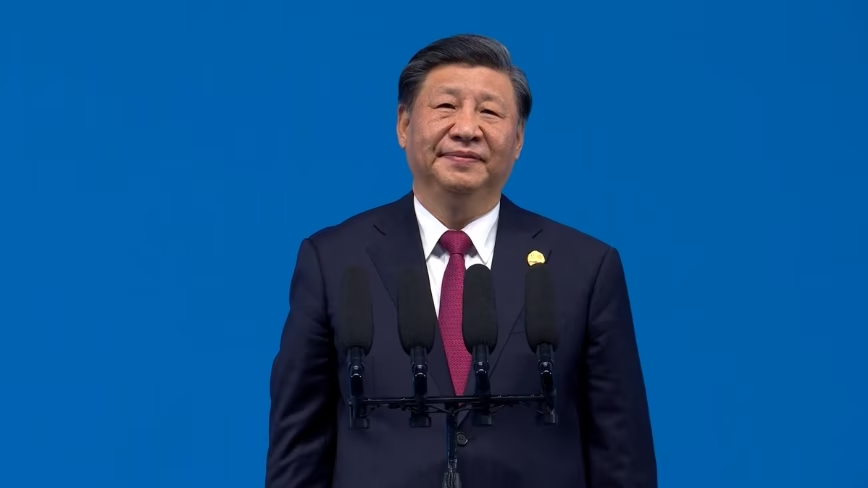
Xi pitches open-source AI to BRICS amid domestic curb debates
Chinese President Xi Jinping proposed a China-led open-source AI community and invited BRICS nations to join the World AI Cooperation Organization (WAICO) at the recent BRICS summit. This push for global collaboration contrasts sharply with Beijing's ongoing internal debates about restricting its own advanced AI models. Meanwhile, the EU's comprehensive AI Act, with its clear, enforceable rules for open-source AI, highlights a significant divergence in global AI governance approaches.

The Party's Back! Tales from '85 Unleashes Season 2 on Netflix
Stranger Things: Tales from '85, the animated spin-off, returns to Netflix on September 17th with 10 new episodes. Set between seasons 2 and 3 of the original live-action series, Season 2 sees The Party facing ghostly apparitions and strange creatures around Valentine's Day. While it received mixed reactions initially, it retains the 80s vibe and core characters.

StarCraft Returns in 2030 as Open-World Shooter
Blizzard Entertainment announced a new StarCraft game, an open-world shooter, set to release in 2030. Unveiled at BlizzCon by VP Dan Hay, this marks the series' return after over a decade and a significant genre shift from its real-time strategy roots. The cinematic trailer showcased a gritty human-Zerg conflict, with many fans hoping for a traditional RTS follow-up.

Tesla Set to Finally Unveil Second-Generation Roadster on October 1
The much-anticipated second generation of the Tesla Roadster, a halo vehicle promising revolutionary performance, is finally slated for a public unveiling on October 1. After years of delays and a protracted development

Seattle Warned on Big Tech Reliance; Microsoft/OpenAI Sued; Apple's
A new City of Seattle study warns of the city's risky economic over-reliance on a few dominant tech companies. Simultaneously, the Seattle Times and Newsday are suing Microsoft and OpenAI for alleged AI training data theft, while Apple's new foldable iPhone Duo evokes memories of Microsoft's defunct Surface Duo.