
ai: Musk’s faster path to more gas turbines comes with pollution
Elon Musk's SpaceX is building a secret Texas foundry to produce gas turbine blades, aiming to accelerate AI data center power by 18 months. This addresses a critical energy bottleneck, but faces environmental backlash over pollution and health risks from gas turbines.

Elon Musk has announced a significant — and controversial — move to accelerate the buildout of AI infrastructure. SpaceX, under Musk's direction, has been secretly constructing a foundry in Bastrop, Texas, specifically designed to cast complex gas turbine blades. This initiative aims to overcome a critical bottleneck in natural gas turbine production, potentially bringing new power generation online up to 18 months faster. However, this rapid expansion of gas power comes amidst escalating environmental concerns and legal challenges over turbine-related pollution.
The AI Power Grid Bottleneck
The "why" behind Musk's gambit stems from the unprecedented energy demands of the burgeoning artificial intelligence sector. While GPU shortages remain a challenge, a more fundamental constraint has emerged: the physical power grid itself. Projections from the International Energy Agency indicate that global data center electricity consumption is set to nearly double by 2030, a surge that current infrastructure is struggling to accommodate.
This escalating demand has already led major gas turbine manufacturers, such as GE Vernova, to report being largely sold out of production capacity until 2030. Consequently, tech giants like Amazon, Google, Meta, OpenAI, and Microsoft, often referred to as hyperscalers, have pivoted. They are increasingly bypassing conventional grid connections by building their own private gas-fired power plants adjacent to new data centers, prioritizing speed in bringing AI capacity online over a long-standing commitment to renewable energy sources.
Solving the Turbine Blade Bottleneck
Musk's focus on in-house turbine blade manufacturing targets a particularly intricate and restrictive part of the supply chain. The blades within a gas turbine's hottest section operate at extreme temperatures, ranging from 3,000 to 3,600 degrees Fahrenheit. This is significantly hotter than the melting point of the metal alloy used, necessitating advanced internal cooling channels and thermal-barrier coatings.
Crucially, each blade must be cast as a single, unbroken crystal, a slow and precise process conducted in a vacuum furnace to prevent microscopic seams that can lead to structural failure under stress. This highly specialized technique, mastered by only four companies globally at an industrial scale, makes mass production challenging. Power-plant turbine blades are considerably larger than those found in jet engines, exacerbating the difficulty of achieving defect-free casting at scale. If successful, SpaceX would gain a unique and difficult-to-replicate manufacturing advantage in the race for AI dominance.
Mounting Environmental and Health Concerns
While Musk champions this acceleration as a "profound game-changer" for AI, it also signifies a deeper reliance on a fuel source already mired in environmental controversy. The increased deployment of natural gas turbines is triggering significant pushback from communities and environmental organizations across the country. These groups point to the turbines' emissions, which include smog-forming compounds and hazardous chemicals like formaldehyde, substances strongly linked to serious health problems such as asthma, respiratory diseases, and various cancers.
In Memphis, for example, the NAACP has launched federal lawsuits against SpaceXAI, alleging that its Colossus data centers have been operating gas turbines since 2024 without necessary permits or adequate pollution controls. Researchers from the University of Memphis have also noted a slight worsening of air pollution in neighborhoods already burdened by industrial emissions near the data center site.
The concerns extend beyond Memphis. Virginia's "Data Center Alley" has become another flashpoint. A study commissioned by the Piedmont Environmental Council, utilizing the EPA’s COBRA health-impact model, estimated that emissions from just one data center's eight gas turbines could affect over 2.5 million people across multiple counties. The analysis projected an additional 3.4 to 6.5 premature deaths annually, with health-related damages potentially ranging from $53 million to $99 million each year, disproportionately impacting marginalized communities. This escalating pattern of environmental and public health grievances underscores the societal cost of rapidly expanding gas-fired power generation for AI.
Implications and Outlook
Musk's audacious plan to vertically integrate turbine blade manufacturing reflects the intense pressure to scale AI infrastructure rapidly. While offering a potential solution to a critical energy bottleneck, it simultaneously intensifies the debate around the environmental footprint of technological advancement. The trade-off between speed-to-market for AI capabilities and the public health and environmental consequences of fossil fuel reliance is becoming increasingly stark, setting the stage for more conflicts and scrutiny as the AI boom continues.
FAQ
Q: Why is Elon Musk building a foundry for gas turbine blades? A: Musk's SpaceX is building the foundry to overcome a critical manufacturing bottleneck in producing gas turbines, which are essential for powering the rapidly expanding AI data centers. By casting turbine blades in-house, he aims to accelerate the deployment of natural gas power by up to 18 months, addressing the significant power grid shortage facing the AI industry.
Q: What are the environmental concerns associated with more gas turbines? A: Natural gas turbines emit pollutants, including smog-forming compounds and hazardous chemicals like formaldehyde. These emissions are linked to various health issues such as asthma, respiratory diseases, and certain cancers. Environmental groups and communities are filing lawsuits and commissioning studies, citing concerns about increased air pollution and its disproportionate impact on marginalized communities.
Q: How difficult is it to manufacture gas turbine blades? A: Manufacturing gas turbine blades is exceptionally difficult because they must withstand extreme temperatures (up to 3,600°F) that exceed the metal's melting point. Each blade needs to be cast as a single, unbroken crystal in a vacuum furnace, a slow and precise process that only a few companies worldwide have mastered at an industrial scale, especially for the larger blades used in power plants.
Related articles

Apple Unveils iPhone Duo: Pricey Foldable Sees Soaring Demand
Apple has officially entered the foldable smartphone arena with the long-anticipated launch of the iPhone Duo. Priced starting at a hefty $1,999, the device features a 5.4-inch outer display and a larger 7.6-inch inner

in-depth: Chicago-Area Cops Helped HSI Spy on Minnesota Anti-ICE
Chicago-area law enforcement, including local police and HSI agents, conducted undercover surveillance on Minnesota anti-ICE activists at an April 2, 2022, talk in Chicago. This operation was part of a federal conspiracy probe into 15 Minnesota activists facing felony charges related to immigration enforcement resistance. Civil liberties advocates have condemned the surveillance as a troubling intrusion into protected political activity.
TCG Pocket Responds: A Much-Needed Pace Shift for Pokémon Fans
Pokémon TCG Pocket is rolling out a major update for its second anniversary, primarily addressing player concerns about overwhelming content releases by shifting to a six-week set schedule. This aims to curb player decline and improve overall engagement by giving trainers more time to collect and strategize. The update also adds new collection methods, improved deck-building features, and enhanced trading functionality.

Mark Wahlberg on using AI in film ‘the right way’ and being open to
Actor Mark Wahlberg believes AI has a place in filmmaking if used responsibly for enhancement, not script generation or actor replacement. At TechCrunch Disrupt, he expressed openness to an AI likeness carrying on his legacy, managed by his family, and emphasized storytelling.

Apple iPhone Duo: A Daring Debut with Notable Compromises
Apple's highly anticipated iPhone Duo, priced at $2,000, has gone on pre-order. While hailed as "Apple's most exciting device in a decade" for its innovative foldable design and immersive display, it comes with significant drawbacks like the absence of FaceID and a premium camera.
Tesla Unveils Thruster-Equipped Roadster, 2028 Production Targeted
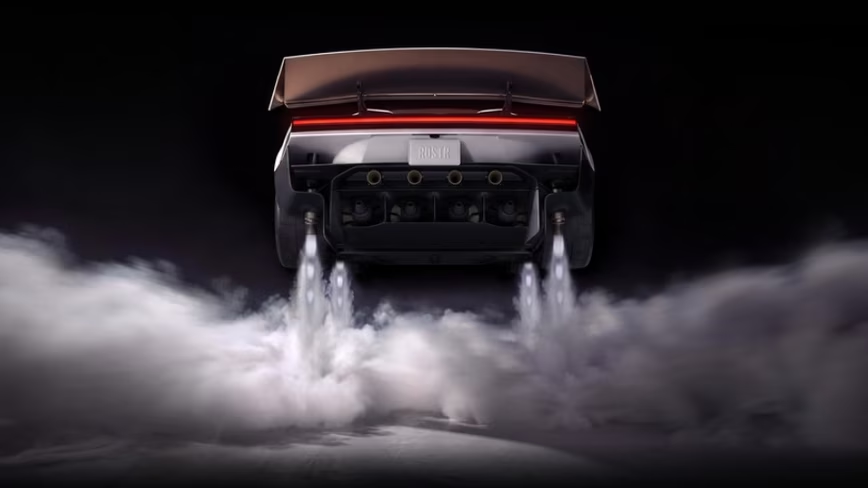
Tesla has unveiled its second-generation Roadster, featuring cold-gas thrusters co-developed with SpaceX, enabling it to jump and flip. The electric sports car demonstrated 0-60mph in an astonishing 0.81 seconds, with production targeted for 2028. This highly anticipated reveal also serves as a key recruitment tool for Tesla's ambitious AI and robotics initiatives.